

Contents
In every boardroom, there is a ghost in the machine.
You see it in the friction that slows down a critical product launch. You feel it in the sudden, unexpected resignation of a top performer. You hear it when a brilliantly designed strategy dies quietly in the corridors of the office. When executives try to diagnose these failures, they usually reach for comfortable euphemisms. We blame “culture.” We cite a lack of “alignment.” We write off lost talent as a “poor fit.” We treat leadership as an invisible, abstract art that only becomes obvious when the damage is already done. But after 25 years of observing leaders under extreme pressure, Paul Kinkaid, Founder and Managing Director at Forenisc Outcomes, realised a brutal commercial truth: leadership isn’t invisible at all. It leaves a definitive, measurable evidence trail. You just have to know how to look at the scene.
The Crucible of Observation
In those environments, leadership is not a theoretical exercise debated over a whiteboard; it is a matter of survival. Over two decades, Paul observed leaders operate across the military, corporate, and public sectors. He saw brilliant leaders who inspired deep, unwavering loyalty. And he saw toxic leaders who, as he describes it, “would dust you with their poison just by entering the room”. The defining difference between the two rarely came down to their strategic brilliance or their charisma on a stage. It came down to their micro-interactions. The brief, everyday moments of friction, dismissal, clarity, or support were entirely dictating the team’s performance. Paul realised that if we wanted to fix poor leadership and stop it from eroding the bottom line, we couldn’t rely on generic management theory. We needed an objective, evidence-based way to track human interaction.
The Breakthrough: Dr. Edmond Locard
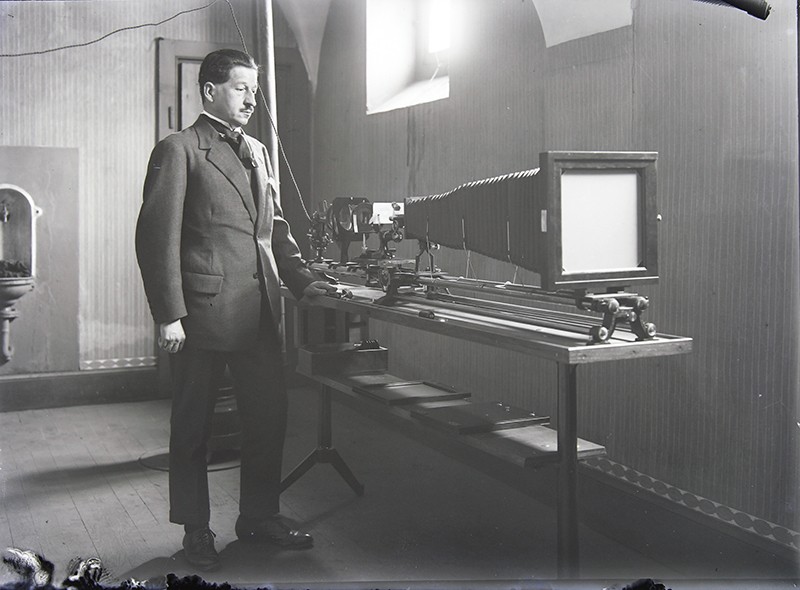
Edmond Locard (1877–1966) was a pioneer in forensic science who became known as the Sherlock Holmes of Lyon, France.
The missing link didn’t come from a business school; it came from the origins of criminal investigation. Paul discovered the pioneering work of Dr. Edmond Locard, a man known as the “Father of Forensic Science” and the Sherlock Holmes of early 20th-century France. In 1910, Locard established a rule that completely revolutionised how crimes were solved. Known as the Locard Exchange Principle, it boils down to one undeniable scientific truth:
“Every contact leaves a trace.”
American criminologist Paul Leland Kirk later expanded on this beautifully:
“Wherever he steps, whatever he touches, whatever he leaves, even unconsciously, will serve as a silent witness against him… Physical evidence cannot perjure itself, it cannot be wholly absent. Only human failure to find it, study and understand it, can diminish its value.”
Connecting the Dots: Leadership as Evidence
For Paul, the connection was absolute. This scientific law applies flawlessly to human behaviour in the workplace.
Just as a physical contact leaves physical evidence, a fingerprint, a fibre, a tool mark, a leader cannot interact with an employee without leaving a psychological and behavioural imprint. Every single time a manager speaks, listens, ignores, or reacts, they leave a silent witness behind:
-
Red Traces: Arrogance, public blame, or dismissing an idea triggers an ancient, survival-level threat response in the human brain. These negative traces root deeply. Through emotional contagion, one “red leader” can rapidly spread friction, cognitive drag, and fear across an entire department.
-
Green Traces: Conversely, when leaders notice effort, provide context, and support growth, they leave positive traces. These compound quietly over time, building the psychological safety, fierce loyalty, and discretionary effort that drives high-performing companies.
When executives finally understand this, “culture” stops being a mystery. Culture is simply the sum total of the behavioural traces your leaders are leaving behind every single day.
The Asymmetry of Green Traces
Green Traces are created when employees feel seen, heard, valued, and trusted. They emerge from listening, constructive feedback, individual recognition, and consistency between what a leader says and what they do. But here is what makes the challenge of green leadership uniquely demanding: Green Traces are neurologically weaker than Red Traces.
Because a green interaction does not trigger the limbic system’s survival response, it does not anchor itself in the brain with the same force. As Paul Kinkaid explains in the book: green traces tend to fade because they don’t have the same power to overwhelm our physiological system. They must be consistently replenished. A single act of recognition in January will not carry a team through to December.
The Formation of Forensic Outcomes
This methodology is our core essence. Because if a leader is unknowingly leaving a trail of red traces across a business, the business will ultimately pay for those outcomes. The evidence doesn’t lie: it shows up in the erosion of your corporate memory, the soaring costs of recruitment, and the bleeding of your top talent to competitors. In his book, Paul shares the story of a Managing Director who lost three of his brightest people to a single toxic manager. The MD later admitted:
“Those resignations meant that I lost a total of 37 years of corporate knowledge, client relationships, and sector experience in one go… I take a huge amount of the responsibility for simply not noticing it.”
That is a forensic outcome.
We built this firm to help executive boards stop guessing. By learning to look at leadership through a forensic lens, you can finally find, study, and measure the behavioural evidence in your business, long before it costs you your best people or stalls your strategic growth.
Read the Full Story
If you are responsible for people strategy, succession, or execution risk, you cannot afford to treat leadership as an invisible assumption. Paul Kinkaid has documented the complete methodology, the psychology behind emotional contagion, and his 25 years of observation in his book, Forensic Leadership: The Traces We Leave Behind. It is not just a leadership book; it is a working manual for reading the evidence in your own organisation.
Request a paperback copy of our best selling book: Forensic Leadership: The Traces We Leave Behind
CONTACT
Ruth Osei
Marketing Manager
Email: ruth@forensicoucomes.com